
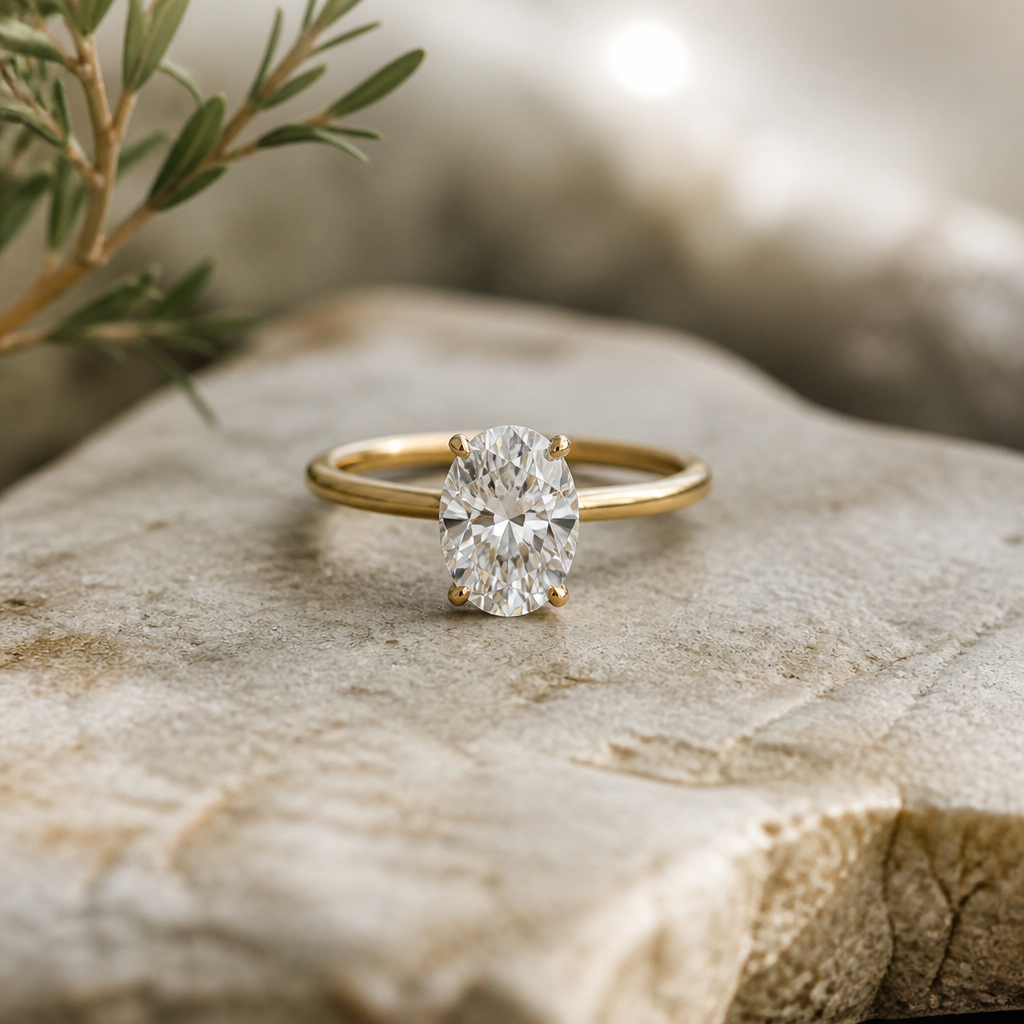
For generations, buying a diamond meant accepting a complicated supply chain — one that involved large-scale mining operations, environmental disruption, and, in too many cases, serious questions about labor conditions and conflict financing. The "blood diamond" era may feel like it belongs to history, but the structural challenges of mined diamond supply chains persist in subtler, often less-reported ways.
Today, a growing number of consumers are asking better questions before they buy. Where did this stone come from? Who was affected by its extraction? What is the environmental cost? And increasingly, those consumers are finding that lab-grown diamonds offer compelling answers — without requiring any compromise on the beauty, durability, or meaning of the gem itself.
The Environmental Footprint of Mining vs. Lab Growth
Conventional diamond mining is an inherently disruptive industrial process. Open-pit mines, the most common method used for gem-quality diamonds, involve the removal of enormous quantities of earth — often hundreds of tons of rock for every single carat of diamond recovered. The land disruption can be severe and long-lasting, with mine sites leaving behind pit lakes, altered drainage patterns, and soil structures that take decades to recover, if they recover at all.
Energy consumption in mining operations is significant, particularly for underground mines where ventilation, lighting, pumping, and ore transport all require continuous power. Water usage is another concern: diamond processing involves washing and sorting ore, and water management at remote mine sites can affect local watersheds.
Lab-grown diamonds, by contrast, are produced in controlled facilities. While the CVD (Chemical Vapor Deposition) process does require substantial energy — microwave reactors operating at thousands of degrees — the footprint is fundamentally different. No land is disturbed. No wildlife habitat is fragmented. No waterways are redirected. And as renewable energy becomes more widely integrated into manufacturing operations globally, the carbon footprint of lab-grown diamonds continues to improve.
Several leading lab-grown diamond producers have already committed to powering their growth chambers with renewable electricity, further reducing the gap between their carbon footprint and that of conventionally mined stones.
Ethical Labor: Knowing the Hands Behind Your Gem
The Kimberley Process Certification Scheme was introduced in the early 2000s to stem the flow of conflict diamonds — stones mined in war zones and used to finance armed conflict against governments. While the Kimberley Process has had some success, critics have consistently pointed out that it only addresses the most extreme category of ethical concern: diamonds financing active armed conflict. It does not address poor labor conditions, inadequate wages, child labor in artisanal mining contexts, or the broader question of community benefit-sharing.
Lab-grown diamonds sidestep the entire supply chain ethics question for a simple reason: the journey from carbon gas to finished gem happens in a factory, in a country with known labor laws, under conditions that can be audited and certified. When you buy a lab-grown diamond from a reputable jeweler, you know that no artisanal miner worked in a hand-dug pit without proper safety equipment. You know that no community was displaced to make room for a large-scale mining concession. You know the hands that shaped your gem, and you can feel good about them.
Brands like EX3 Diamond take this transparency a step further — hand-faceting and hand-setting every diamond they sell right in Illinois. This direct-to-consumer, domestically crafted approach means buyers know exactly where their jewelry was made, by whom, and under what conditions.
Quality: Lab-Grown Diamonds Are Not a Compromise
One of the most persistent misconceptions about lab-grown diamonds is that they are somehow lesser — a budget substitute for people who cannot afford the "real thing." This misunderstands what lab-grown diamonds actually are. Chemically, physically, and optically, a CVD lab-grown diamond is a real diamond. It is composed of pure carbon in the same cubic crystal lattice as a mined diamond. It has the same hardness (10 on the Mohs scale), the same brilliance, the same fire, the same thermal conductivity.
The Gemological Institute of America grades lab-grown diamonds on exactly the same 4Cs scale — Cut, Color, Clarity, and Carat weight — as mined diamonds. A D-color, VVS1-clarity lab-grown diamond receives the same grading certificate as a D-color, VVS1-clarity mined diamond. The gem is not inferior. The process by which it was created is simply different.
What lab-grown diamonds do offer that mined diamonds cannot is better value. Because the production timeline is weeks rather than millions of years, and because the supply is not artificially constrained by mining concession geography, lab-grown diamonds cost significantly less per carat than mined stones of equivalent quality. For buyers, that means access to larger or higher-quality diamonds within the same budget — or simply the satisfaction of knowing they paid a fair price rather than one inflated by historical marketing monopolies.
The Meaning Is Yours to Give
Some buyers worry that a lab-grown diamond lacks the romance or the metaphysical weight of a stone that formed deep in the earth over billions of years. This is an entirely personal consideration, and it deserves a thoughtful response rather than a dismissal.
The meaning we assign to diamonds has always been a cultural construct, not an intrinsic property of the stone. Diamonds became associated with engagement and eternal love not because of geology but because of a marketing campaign launched by De Beers in the mid-20th century. The gem itself carries whatever meaning its wearer brings to it. A diamond given as a symbol of commitment, love, or celebration carries those values whether it was formed in a geological event or in a laboratory. Many couples today find that choosing a lab-grown diamond is itself a meaningful act — a statement that their love does not require the extraction of a finite natural resource or the compromise of someone else's wellbeing.
For buyers ready to make a considered, values-aligned choice without sacrificing quality or beauty, EX3 Diamond offers a range of hand-set, hand-faceted fine jewelry built around certified CVD lab-grown diamonds. Each piece is crafted with the same care and precision you would expect from a fine jeweler — because that is exactly what it is.
Making the Switch: What to Look For
If you are ready to explore lab-grown diamonds, here are a few things to keep in mind as you shop. First, ask for a grading certificate from a recognized gemological laboratory such as the GIA or IGI. A certified stone gives you an objective, third-party assessment of its quality, so you know exactly what you are buying. Second, ask whether the stone has been post-growth treated. Some lab-grown diamonds undergo HPHT (High Pressure High Temperature) treatment to improve color; there is nothing wrong with this, but it should be disclosed. Third, pay attention to cut quality. As with any diamond, the cut determines how much light the stone reflects. A beautifully cut lab-grown diamond will outshine a poorly cut mined diamond of the same carat weight every time.
The shift toward lab-grown diamonds is not a passing trend. It reflects a deeper, structural change in how consumers think about value, transparency, and responsibility. As the technology continues to improve and prices continue to adjust, lab-grown diamonds are poised to become not an alternative category but simply another expression of what a diamond can be — one that happens to come with a cleaner conscience and a more accessible price tag.
]]>